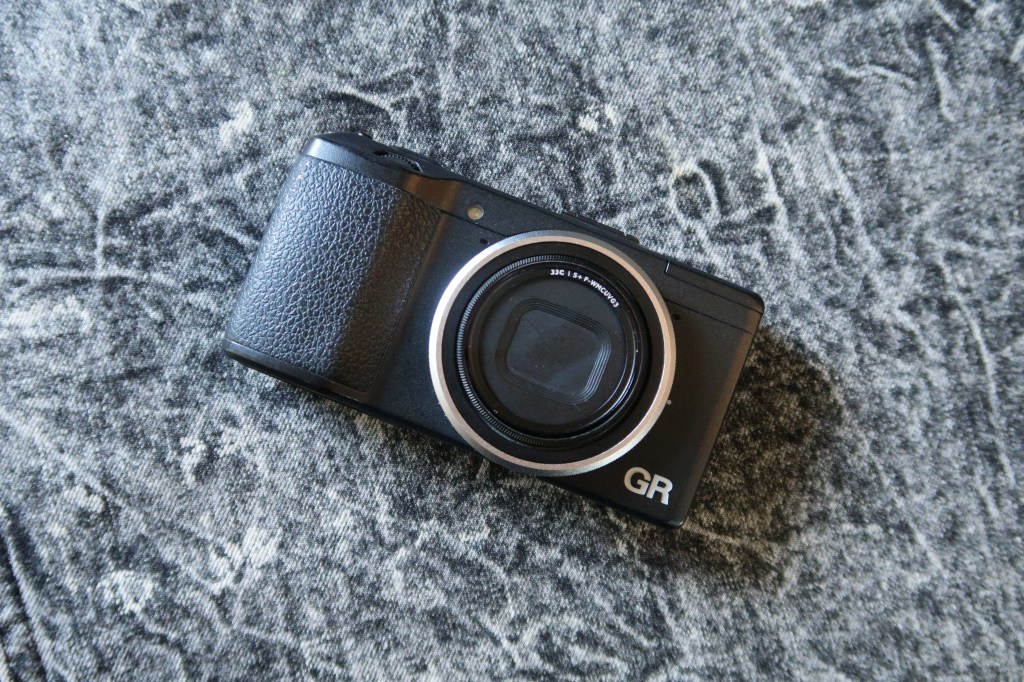
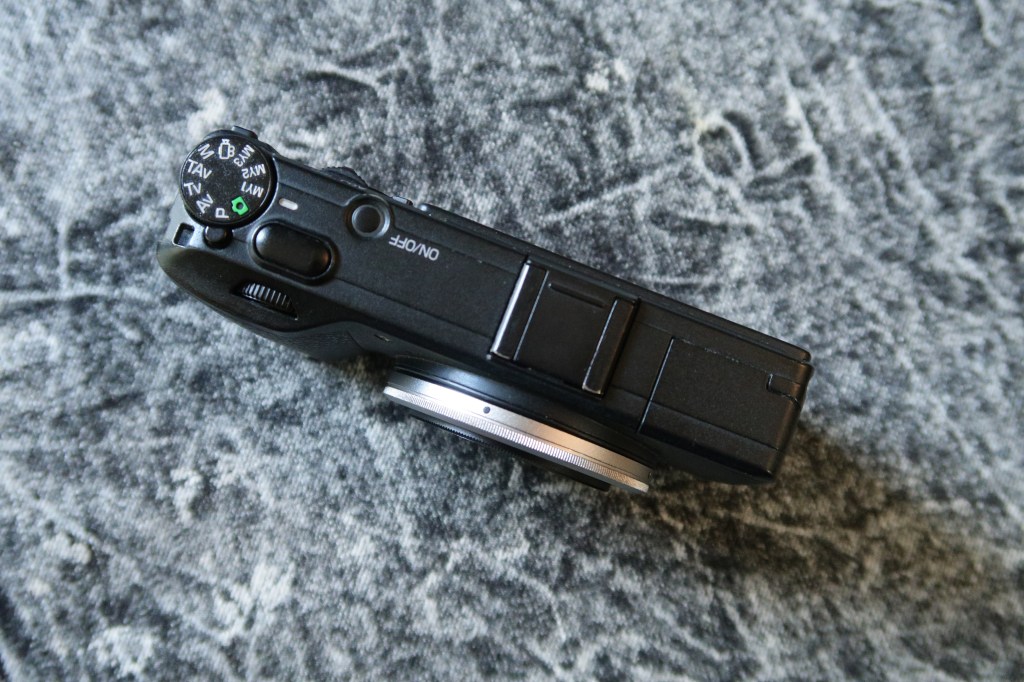
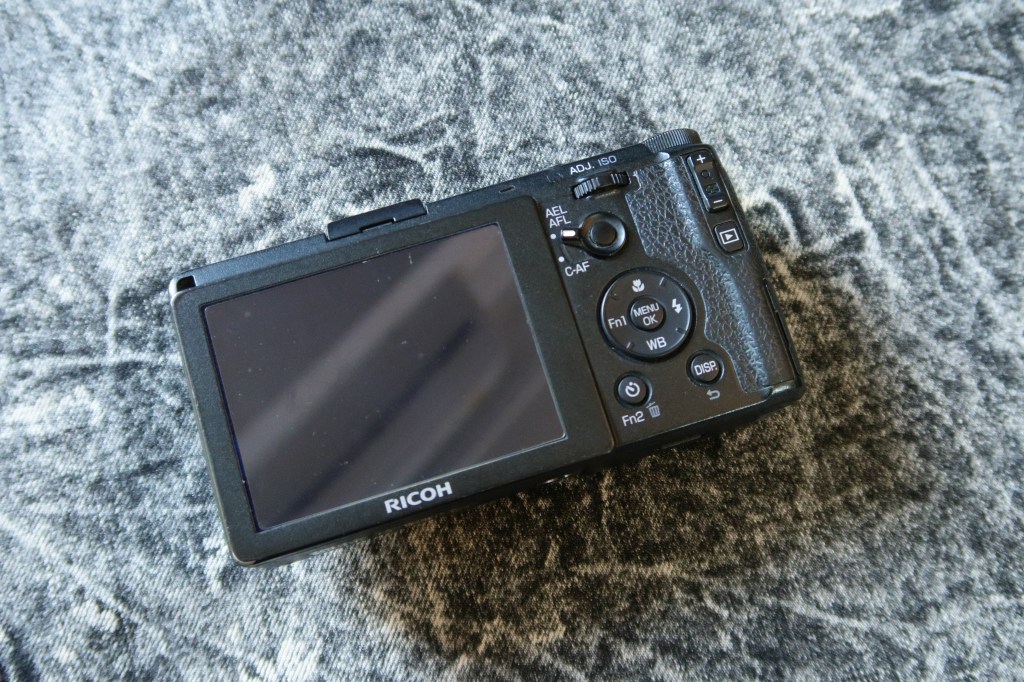

The Ricoh GR is one of the most successful camera productions of the past 2 decades – evidenced by the continual release of new versions. While at a glance – the camera has few design changes other than the dimensions/placement of buttons since the original version was released as a 35mm film camera in 1996. However, the most recent version as of this writing is referred to as the Ricoh GR IIIx – which deviates from the wide angle 28mm focal length the GR series is renowned for and instead is equipped with a standard 40mm equivalent focal length lens. More on this change later.
I first discovered the GR series at a local camera shop in Hanoi. They had a Ricoh GR10 which seemed like the better choice than the GR1s which they also had. The GR10 didn’t work right from the start. It’s a budget version in most respects of the GR1, and mine was dead on arrival. The shop allowed me to return and pay double the price for the GR1s. Just the feel of it was an indicator that I was now holding a much better camera. The GR1 is a magnesium body with plastic, metal, and glass sub-parts. I loaded some film and got 4 rolls before the flex cable snapped and I was left with a paper weight. Back to the shop I went. This common issue which dooms all 35mm film GR’s to a certain yet random death is talked about at greater length here.
Saddened by the short-lived experience with the GR1s – especially after getting some photos back from the first few rolls of film I shot with it, I longed for a solution but was not willing to waste another $600 on a paperweight.
I tried the even cheaper Ricoh R1s, and loved the results and much lower price, but the lack of manual controls and premium features like SNAP – which allows the photographer to take a photo at a predetermined focal length without focus delay for candid street shots – was missing. To note, the R1s doesn’t have the same lens – it has a 30mm lens that can be switched to a 24mm ultra-wide panorama mode. Very cool!
So, what could I do to enjoy the incredible Ricoh GR lens without wasting a fortune on fallible cameras? Go digital! But wait – why go digital? Isn’t film photography the best? Yes and no. Film photography is great for the rich or people that have a purist notion about shooting film, or those that have a darkroom – and many other scenarios that I won’t go into. I still shoot film, but the benefits of the GR series form factor, one of the best ergonomic camera designs, and a host of really cool features that I do dare to say make the film version obsolete. And these features are what we are going to dive into here.
I first ordered the Ricoh GR “digital” III – a 2011ish 10-megapixel version of the GR. It got dust on the sensor which is the one downfall of these digital versions vs the LCD and flex-cable failure of the film versions. The 10mp version can focus as close as 1cm in macro mode! It has a broad range of artistic filters – most of which emulate films. Unfortunately, the GR Digitals (as they were called pre 2013) are too difficult to open and remove dust from the sensor. So I found a 2013 Ricoh GR which is a bit larger to hold, but still pocketable and with 16 megapixels and even more advanced features/filters. My favorites are Positive Film – which simulates the look of 35mm slide film, and High-Contrast B/W (Monochrome). The latter resembles a slightly grainy film pushed to a higher iso (think Tri-X 400 pushed to 1600). Here’s an example of the high-contrast B&W (unedited)…


The GR lens combined with this filter makes a statement. The lens resolves so well, and this filter creates images that almost make the viewer (that’s you!) think I know what I’m doing. I also discovered enhanced film simulation options at Richie’s site, https://ricohrecipes.com/. There’s some really great stuff, and in the process of adding these to my Ricoh GR – I got a deeper insight into the camera’s sub-menus including how to adjust the white balance by temperature and color.
Another interesting feature about the body of the Ricoh GR non-film cameras is that the bodies can easily attach filters which wasn’t an option until the film GR1v – which costs about $800-1000 if in good working order. My GR came as a combo with a filter attachment and a cool square funnel-shaped lens hood. I put a circular polarizing filter on plus used the “cross-process” filter to get these shots:


The recent GR series (megapixels rather than film) have one flaw – dust can enter through the lens extension parts/process when the camera is turned on/off. My 2nd purchase of a non-film GR – the 16-megapixel version from 2013 had this issue too. My past tinkering with mechanical camera repairs was an asset as I was able to follow directions on a site that explains how to open the camera and by using a camera air blower (don’t use canned pressurized air) was able to clean the filter – resolving the issue. You can find instructions here.
If you want to avoid this, the aforementioned filter attachment can isolate the lens during extension and protect it, but it adds bulk. What I chose instead was a cheap jjc lens cap available at my affiliate link here. This keeps dust off the lens housing so there’s no dust to get sucked in when you pull the GR out of your pocket for a candid street shot without the time to use a lens brush or cloth to wipe it before turning the camera on. If you forget the cap is on – it just falls off when the lens extends, and you’ll still get that shot! Also, to test for this if you’re buying used – in person, set the aperture to something small like f8 or above and take a photo of a sheet of paper or solid colored wall. You’ll see a dot on the image where the dust is. You can ask the seller to do this if buying from an online marketplace – just be sure to ask for the raw file so they don’t edit it and send a .jpg.
I found the GR performed exactly as I had read for candid street photography on a recent trip to Bangkok, Thailand. I was able to get many shots while remaining discreet so that people wouldn’t change their expressions. Also, the lens on this camera devours inner city landscapes and then freezes them in a highly resolved way. I haven’t found another camera that can quite do it exactly like the GR even at similar focal lengths and settings. More sample shots…


The most recent versions of the GR are limited edition colored bodies like the Diary Edition, Street Edition, and also the 40mm equivalent Ricoh GRIIIx. All of the GR (I, II, III and IIIx) have a digital crop feature that can be really nice for framing. For example, say you want to frame shots at 35mm equivalent rather than the wide 28mm, you can choose this and even assign it to a FN button. Each model has 3 options – the 28mm GRI/II/III has 28mm, 35mm, and 56mm crop. I love this as I also love the Contax TVS camera – but the GR gives a faster f2.8 aperture! Some people don’t like this as it just crops the photo digitally rather than being an actual zoom or new focal length. The camera has such a large sensor and sharp lens that I found jumping from 28mm to 35mm cropped was still great. Another option is to shoot raw+jpg so you’ll still have raw at 28mm.
One important difference from the GR I/II vs the GR III is that the GR III doesn’t have a pop up flash. For me personally – while I rarely use it, having the flash is useful. I believe this design choice was made to pack more performance into the GR III with a byproduct that low-light noise will be reduced enough to not need a flash. One case where the flash is useful is taking photos that have bright sky backlighting – in my case cherry blossoms on a tree mid-day taken from below. It’s such a rare situation that can also be resolved in post-processing so I call it a wash.
So to recap, if you’re looking for a camera that can fit in your pocket and go everywhere, has a robust feature set, and an amazing lens in your choice of either 28mm or 40mm (equivalent) focal lengths, but you also want a more professional feature set/large sensor – the Ricoh GR series should hit the spot.
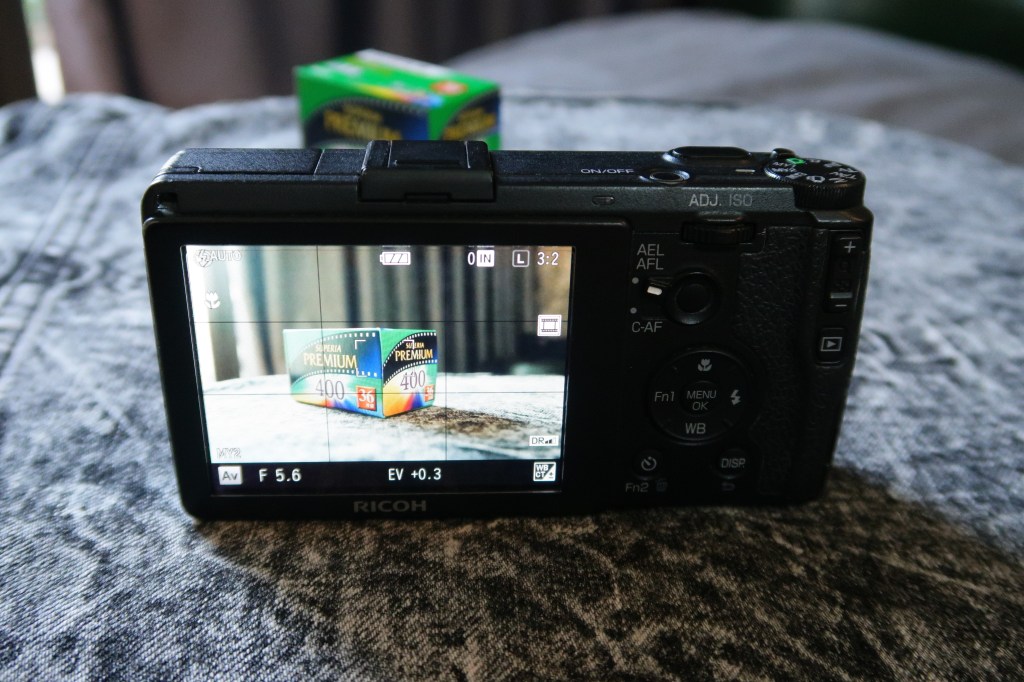
As for lack of viewfinder – there are external shoe-mount viewfinders for it, but my solution is to just imagine that I have a massive 3” viewfinder on the back – sort of treating the whole camera like a little window into reality that freezes moments for me to view later.
To get your own Ricoh GR and help support a photography blogger – please consider using my affiliate link and get yours here. Thank you and happy shooting!
References:
Buyer’s Guide on Japan Camera Huter
 VijnBord
Leave a comment