Olympus XA film camera designer Yoshihisha Maitani.

Yoshihisha Maitani became employed by Olympus in 1956 and was a designer for over 40 years with the legendary camera company. He is well known for designing 3 of Olympus’ most loved cameras, the Pen F half-frame SLR, the Olympus OM1 – one of the most compact full frame SLR cameras, and the Olympus XA – one of the smallest film cameras to include a range finder, sliding cover, and aperture priority metering.
His goal with the OM series was to reduce the size of the typical SLR (single lens reflex camera) by half. He used the competitor Nikon’s flagship camera the F series as the reference point. He succeeded by creating the OM-1 SLR then later eclipsed his own success by creating the Olympus XA – world’s smallest rangefinder full frame (135mm film) camera.
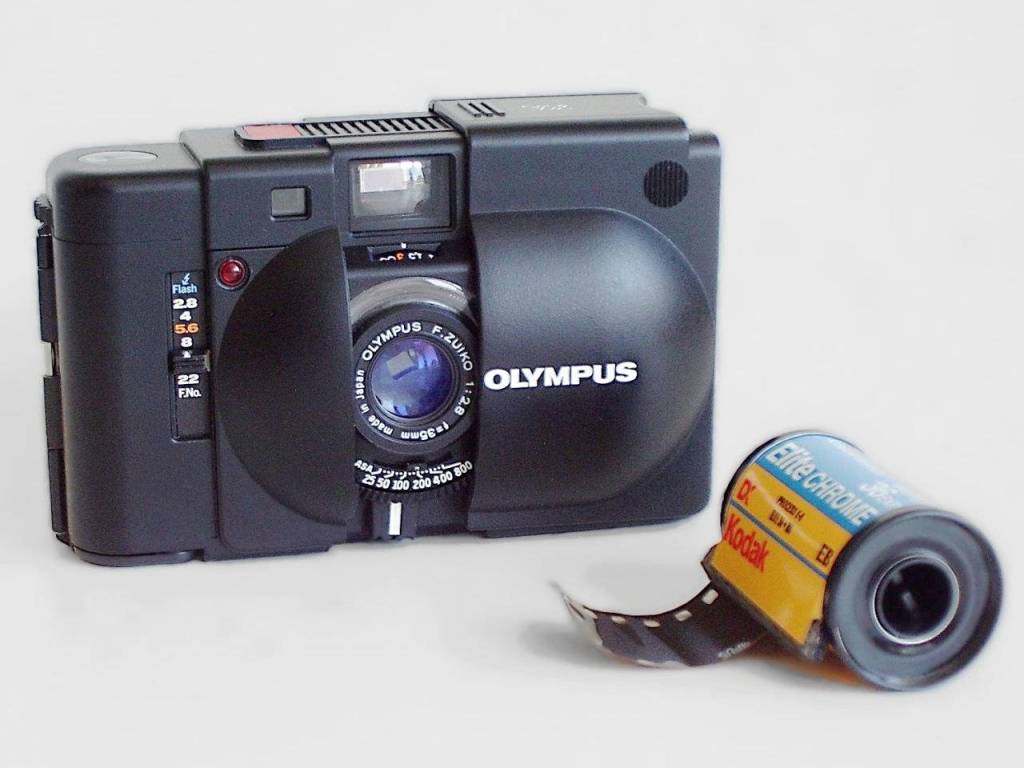
The Olympus XA can fit in a pants pocket, has aperture priority which allows the photographer to decide on the depth of field and indirectly the shutter speed, and has a rangefinder for precision manual focusing. The camera also includes a sliding “clamshell cover” to protect the lens, a battery check switch which also functions as an exposure compensation switch for backlit scenes or a self timer.
What makes the camera additionally impressive is the sharp and fast 35mm f2.8 lens. It’s a semi-wide lens that has great performance – though some complain that there’s light fall-off and vignetting when the aperture is set below f5.6.
Having a full frame camera that fits in your pocket with this feature set is still very rare today as the camera industry shifted to equally small but fully automated cameras that have few if any artistic control options.
The Contax T
Another contender for the best pocket camera is the Contax T. Released in 1984 by Kyocera under their partnership label with Zeiss called Contax (which was a prior Zeiss brand of rangefinder from decades earlier). The brand hired F.A. Porsche for the product design and the combination of the best in class Zeiss lens, titanium body, and a robust feature set make this one of the best pocket cameras ever made. While significantly more expensive and a bit larger than the Olympus XA, the Contax T has a much more premium finish and comes in either silver or black.
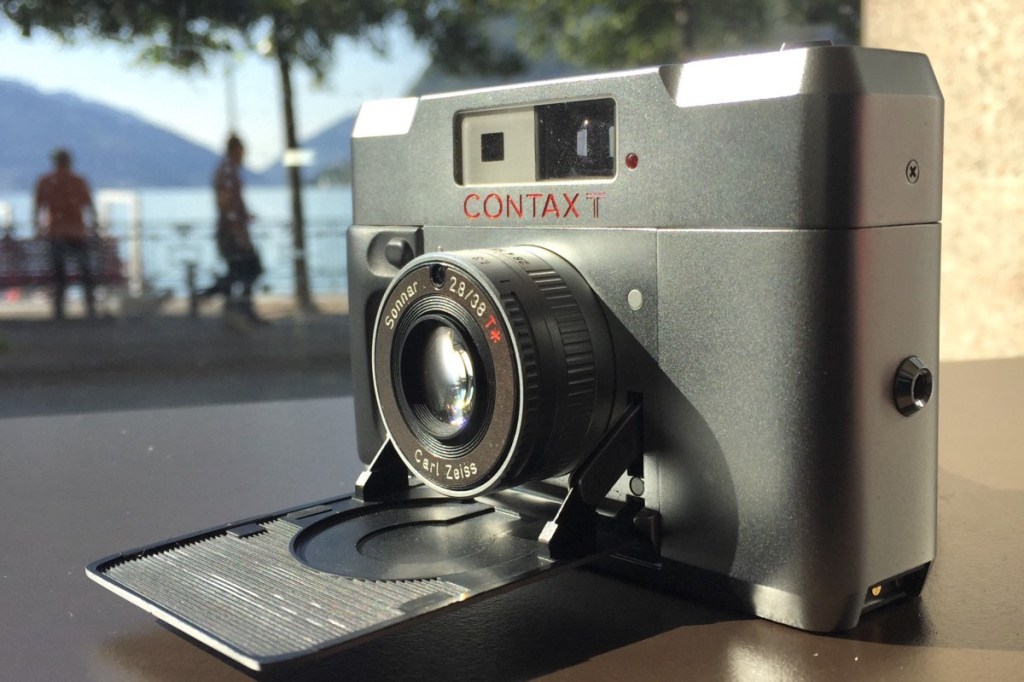
This collaboration is very rare when considering the range of products F.A. Porsche has developed in their design studio – from watches to car accessories, to partnerships with Chinese phone maker Huawei. The sleek design has many references to features we see in the Porsche design ethos such as attention to detail and finely crafted parts – in this case a synthetic ruby shutter button. The lens, a Zeiss 5 element Tessar 38mm f2.8 is highly regarded by photographers and was reused in the Contax T2. This is also a pocket rangefinder with manual focusing and a nice hyper focus feature: When the aperture is set to F8 (which is marked in neon green on the aperture ring surrounding the lens barrel), and the focus is set to the green dot on the focus ring, the camera is said to have almost all back/mid/foreground elements in focus for any shot. This essentially makes this camera faster than a point and shoot!
The Ricoh GR

The original GR1 (top) and the GR digital (bottom).
The next camera differs from the previous two in that while highly pocketable, it is a fully automatic camera that has the option to shoot in aperture priority and has a unique rapid focus feature called SNAP, more on this later. This camera is the Ricoh GR.
In addition to having a full program mode versus aperture priority only, the GR1 has a built-in flash, exposure compensation plus or minus up to 2 stops in half stop increments, additional electronically controlled modes, and a super cool viewfinder with focus indication overlays.

https://www.dpreview.com/forums/post/65549632
Obviously none of these cameras has a “through the lens viewfinder” like an SLR, but they do give us awareness of our focus point and in the case of the autofocus GR1, the indicators in the middle of the viewfinder let us know that focus has been achieved – and we can refer to the zone indicators of flower/person/people/mountains to be sure that we aren’t missing the subject.
One of my favorite features of the Ricoh GR1 series is the SNAP focus. This is a preset focus distance (2 meters or about 6 feet) which allows the camera to take a picture in about 1 second (or less) in the event that you’ve stumbled on a perfect street photo moment that won’t last. This setting overrides the autofocus and works great for close distance shots in crowded areas with almost no delay.
James over at casualphotophile.com has a great review of the last iteration, the Ricoh GR1v. This version offers DX coding override and allows the user to set their own SNAP focus distance, plus a few other minor but useful updates. My experience with the lens is that it’s one of the best 28mm lenses with a reasonably fast aperture of f2.8. It’s an incredibly sharp lens with beautiful color rendition and resolution.
This camera is so well designed and the user experience is nearly flawless. Unfortunately (for those who don’t own one yet) this has increased the price significantly, as has decreasing quantity due to the LCD on top and in the viewfinder failing. Further, the flex cable that attaches the shutter – and possibly the aperture to the camera’s exposure electronics and controls will often break as it is over 20+ years old and has been bent as the lens protrudes possibly thousands of times. The flex cable is replaceable, but I have yet to find a solution for the LCD failure.
In my pursuit of the perfect camera, I discovered a solution to owning a GR and not worrying about it failing – as mine did – after shooting a once in a lifetime roll of film: Buy the Ricoh GR digital camera. There are 2 series of the digital GR with confusing naming conventions. The first series, the Ricoh GR Digital uses a smaller sensor and lower megapixel count but is actually wait for it… smaller than the GR film camera! It also has a macro focus of 1 centimeter! Option B, keep buying and shooting the original film GR1 series ‘til death – and as others have suggested, use the GR1V as it’s the most recent one and perhaps less likely to fail. I was also advised by a fellow photographer to avoid hand rolled film as it may stress the motor on automatic winding cameras.
The next article will be specifically about the Ricoh GR digital versions, so stay tuned! If you enjoyed this article and want to get your own Ricoh GR III, please support me by using this affiliate link if possible.
Thank you for reading,
Daniel
Sources:
https://www.digitalcameraworld.com/features/the-man-behind-the-olympus-om-camera-yoshihisa-maitani
https://gear.vogelius.se/-editorials/olympus-xa/index.html
https://en.wikipedia.org/wiki/Contax_T
https://en.wikipedia.org/wiki/Porsche_Design
 VijnBord
Leave a comment